Friday, May 26, 2023

Cape Town – Day 1 – From atop Signal Hill


The most important landmark in Cape Town is, of course, Table Mountain, and Signal Hill nestles next to it and is also known as Lion’s Rump. When seen together with Lion’s Head, which is another peak next to it, the whole formation appears like a lion sphinx. Thus, the three hills lie adjacent to one another – Table Mountain, Lion’s Head and Signal Hill and can be seen from any point in Cape Town on a clear day.

Signal Hill got its name from the olden days when signals were sent to ships through signal flags to communicate warmings as well as anchoring instructions to visitor ships experiencing stormy weather.

The first two days in Cape Town saw Table Mountain shrouded in clouds. The drive up Signal Hill was picturesque with views of Cape Town below and glimpses of the peaks as the cars cruised uphill. The grey clouds hung ominously overhead as the weather threatened to worsen and we were all thankful that we had worn our thickest jerseys and woollens. The view was beautiful with tantalizing glimpses of Cape Town below and the verdant foliage alongside.


During the colonial era, many respectable Muslims were buried on the hills around Cape Town. One significant tomb that is seen on the way to Signal Hill is the ‘kramat’ or shrine of a Muslim saint named Sheikh Mohamed Hassen Ghaibi which forms part of the Circle of Kramats, or shrines built to honour Muslim saints buried in Cape Town.  It was prophesied 250 years ago that there would be a ‘Circle of Islam’ around the city of Cape Town. The kramat of Sheikh Ghaibi has been nominated for Heritage Status. This historic building has escaped mountain fires four times even when the surrounding areas were ablaze, which is seen as an example of divine intervention.

                                                                        Alamy Stock Photo

When we finally got to the top of Signal Hill, we could barely open our eyes because of the stiff breeze that took our breath away. The video below shows a tree dancing in the wind.

Wrapped in caps and gloves, we braved the chill and gazed at the wonderful panorama that spread before us – the sight of Table Mountain with a ‘tablecloth’ of clouds over it, the stadium below, the sea and a faint glimpse of the famed Robben Island in the midst of the sea and the most wondrous sky lit up in grey and gold.


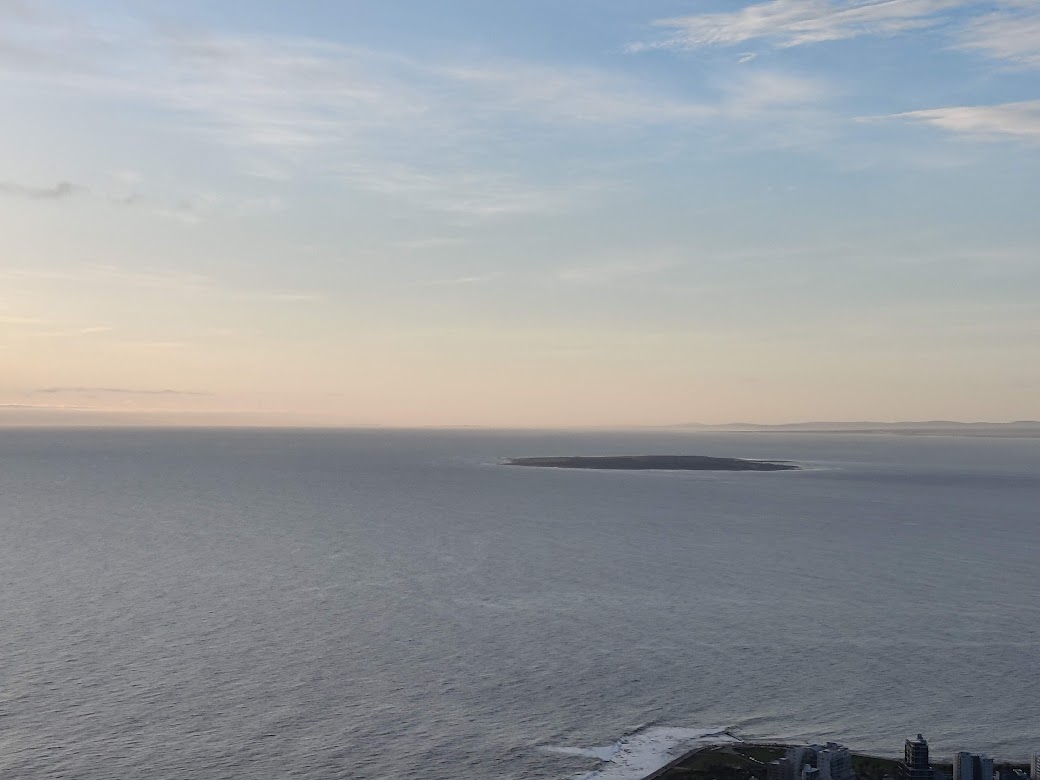


 Even as the wind buffeted us, freezing us to the very bones, we stood and gazed entranced at the view that lay ahead of us. The sun was playing its role to the hilt, showering the earth with golden beams that mantled the sky and the sea with its magnificence. Wordsworth's timeless lines echoed in my ears:

“Earth has not anything to show more fair:

Dull would he be of soul who could pass by

A sight so touching in its majesty.”


“Never did sun more beautifully steep

In his first splendour, valley, rock or hill.” 

(Wordsworth - Composed Upon Westminster Bridge, September 3rd, 1802)

Photo Credits: Deepti Menon


Thursday, May 25, 2023

CAPE TOWN – DAY 1 - THE MALAY QUARTER, DOWNTOWN AND THE AMAZING COFFEE BAR


Once we had finished with Spier Hotel and Wine Farm, we were raring to go to the next leg of our trip.

The gorgeous Malay Quarter, which nestles at the foot of Signal Mountain, took our breath away. The buildings were all tastefully painted in lovely colours, and I could hardly contain myself as we drove around. Pinks and blues, greens and oranges, yellows and reds… the sight was magnificent.

History has it that the Malay Quarter came into being during the third quarter of the 18th century. In the 1830s, when slavery was abolished, it is believed that the Malays who had been forcibly brought into the Cape, now earned their freedom and began to shift into this area. By the middle of the 19th century, this area was dubbed the Islamic Quarter. The presence of this Quarter brought the Cape Malays together as a group, but in 1944, after World War 2, the quarter deteriorated to the extent that it was declared a slum. The City Council and the Historical Monuments Commission acted with the help of prominent citizens of Cape Town because they realized the significance of the quarter. On 15th April 1966, the Malay Quarter was declared a National Monument.

As we kept driving around, we could not help noticing the buildings around the CBD that loomed on either side. They were impressive and each seemed grander than the last.


All the driving had made us thirsty, and we hunted for coffee. The one that we walked into was very different from what one would expect of a normal coffee shop. It was called The Espresso Bar.


Our next leg... onto Signal Hill, where one could have a wonderful view of the Famed Table Mountain and Lion's head.

Photo Credits - Deepti Menon

CAPE TOWN DIARY - DAY 1 - THE SPIER HOTEL AND WINE FARM, STELLENBOSCH


Photo Credit - Spier Wine Farm


Four days in Cape Town. It sounded too good to be true! So, the four grandparents, the parents and the two terrific twosome (Z and S) boarded their flight, filled with anticipation. Each of them had their own ideas about what lay ahead, but one central idea loomed large. They were all set to have the time of their lives.

The week earlier, or at least part of it, had gone into planning our itinerary. After all, there was so much to be done; the problem was in sifting the parts that interested us most. The general view was that it was going to be freezing and that we would have to be clad like Eskimos most of the time. That was daunting (brrrr!) because I suspected that I would have to be thawed out every time I returned home after a jaunt.

We stayed in a friend’s beautiful home which faced a water body which was a kayaking path. At times, kayaks would whiz by, manned by men women and children. A few ducks also made the crossing, and weaver birds had built their intricate nests right next to where we were.

Once we had settled our luggage, it was time to move on to the first leg of our trip – wine tasting at the Spier Hotel and Wine Farm at Stellenbosch. Spier, established in 1692, is one of the oldest family-owned wine farms and prides itself on its beautiful philosophy of respect for the land and a desire to show off the intrinsic value of the Cape.

The picturesque drive to the farm was breathtaking, and this continued even when we reached our destination. 


The green of the grass and the blue of the water body that flanked the farm, made the white Dutch building stand out in its pristine severity.


As we were walking towards the entrance, some sculptures caught our eye. We went closer and were intrigued by the explanation given on the plaque alongside. They were interactive sound structures, and the moment we placed our arms around them from a distance, the sculptures sang a unique song. Apparently, this emanated from an electro-magnetic reading recorded from beneath its placement. The artist, Jenna Burchell, collected twelve fractured rocks of fossilized volcanic ash and she filled in the damaged parts with gold seams. (Kintsugi) It was eerily fascinating to hear these stones sing!


The interior of the Spier Farm was classy and eclectic. The glistening bottles of wine placed in eye-catching rows, the wooden barrels against the wall, the rustic wooded chairs and tables with a merrily burning fireplace at one side did not prepare us for the artistically arranged wine glasses in sets of three placed on a table that had been reserved for us.


It was a most enjoyable session as one of the waitresses explained the various wines that were being tasted, both white and red, and poured them out. Since the two grandmothers were not wine drinkers, we nursed the one that seemed most palatable, while the others swirled the vintage around their mouths and appeared to pick up the full-bodied pineapple and guava hints that the waitress stressed were in them.

The kids had a gala time, sipping on their wine glasses filled with red and green grape juice. What was especially nice was that they too were part of the ritual. Of course, wine on empty stomachs can be heady and so, we ordered two platters which looked and tasted exotic.


Wine and victuals over, we had a look around at the various items for sale… wine bottles, goblets, bottle openers, wooden platters and spoons, oil canisters, varieties of tea, colourful woven baskets and even coffee table books on South Africa.


The ambience was amazing and it was with full hearts and stomachs that we left the Spier Farm.


It was now time to head out to our next destination.

Photo Credits: Priyanka Menon and Deepti Menon

Wednesday, May 17, 2023

THE MAGIC OF MONTE CASINO - JOHANNESBURG

Monte Casino – the very name spells romance, glamour and intrigue. Tucked away in Johannesburg, Fourways, this sprawling structure looms, impressive and eye-catching and is one of the top entertainment spots in the city. The name comes from Monte Cassino, a village near Rome in Italy and the entire complex resembles a typical Tuscan village.

The first time we visited Monte Casino, it took our breath away. The moment we stepped onto the cobbled paths within, it was a different world altogether. From broad daylight and the scorching African sun, we walked into a sunset, an interior that exuded an evening ambience, with closed ceilings that alternated between the day and the night sky.

While the main attraction is obviously the Casino which makes its presence felt with flashing lights, the sound of the counters and the hustle and the bustle, Monte Casino has much more to offer in the form of restaurants offering all kinds of cuisines, stores that show off their wares, little nooks where one finds a lone musician strumming on a guitar, and live music bands that regale the fascinated crowds. There is also a theatre which offers regular movie shows, theatrical performances and much entertainment.

HOME SWEET HOME!

  Pinterest The littlest one of us all was coming home to spend her summer break with Mom. (We were three sisters, till Mom adopted our olde...