Friday, September 30, 2016

Cabbing All The Way by Jatin Kuberker


CABBING ALL THE WAY
by
Jatin Kuberker


Blurb

Twelve people agree to an idea of running a shared transport service from a common residential locality to their out-of-civilisation office campus. Twelve different minds with equally diverse personalities gel with each other to fulfil a common need. At first, the members collide on mutual interests, timings, priorities and personal discipline, but in the course of their journey, they become best friends, make long-lasting relationships, mentor and help each other on various mundane matters. The journey goes on fine until one day some members try to dictate terms over the group. The rift widens with each passing day, the tension surmounts and finally all hell breaks loose... Will the journey continue? Fasten your seatbelts for the journey is about to begin...

Read an excerpt @
Readomania 

  Grab your copy @

        Amazon USA | Amazon India | Amazon UK | Flipkart

Follow the Tour @ Pinterest 


About the author


Take an ounce full of imagination and a scoop of humour. Mix them well. Now put a few teaspoons of feelings and emotions and simmer until it smells good. Add spices for taste. Put the mixture on the platter of dreams and garnish it with a few peanuts of desires and some herbs of passion – that’s all it takes to be Jatin Kuberkar. Jatin is a software engineer by day and a passionate writer by night. When not tangled in software codes, Jatin likes to express his inspirations in the form of poetry, short stories, novels and essays.

He lives in Hyderabad and adorns polymorphic forms in his personal life as a son, a husband, a father, a friend, a mentor, an observer, a criticand the list goes on… He is an ardent lover of Hyderabadi biryani and is a worshipper of chaai. If granted a boon, Jatin would love to learn magic from Hogwarts and fly around on a broom stick. 

Jatin is the author of two other books. Rainbow Dreams, a collection of poetry and While I Was Waiting, a collection of short stories. This is Jatin’s third book.

Stalk him @


Win Amazon Gift Card     


   This Tour is Hosted by 


We Promote So That You Can Write 

Wednesday, September 28, 2016

Rightfully Wrong, Wrongfully Right by Varsha Dixit


The ebullient Varsha Dixit, author of the delightfully titled 'Rightfully Wrong, Wrongfully Right' gives her reasons for choosing an oxymoron in this guest post on Deepti Menon's blog.

"Dear Varsha, it is intriguing how you used an oxymoron in your title, twice over. Is ther a reason for doing so? Was it for the effect on the readers. or because you wanted to stress on something particularly? Do the co,ours red, white and yellow on your cover have any significance as well?

Varsha's reply:
"Here you go! '"I know this is a joyful trouble to you.’ Shakespeare in Macbeth.

‘Joyful trouble’ An oxymoron that pricks the reader, heightens the flavor of writing and creates a wicked visual in the reader’s imagination. An oxymoron is a mish-mash of two contradictory words. In fact, I recently discovered that oxymoron is the combination of the Greek words oxy, which means sharp, and moron, which means dull. Thus, the word itself is a combination of two contradictory words.

Why I use them in titles? Well because they make the title catchy, hard to forget and easy to remember. However, I had never planned to use oxymorons in my book’s title. It just happened that way. When I ran the title, ‘Rightfully Wrong Wrongfully Right’ past my editor and publisher, they jumped on it right way. Still not sure, I ran a poll on Facebook and Twitter and nearly eighty percent of the people voted for ‘Rightfully Wrong Wrongfully Right’. Oxymorons can be catchy! Lesson learnt ☺

As for the colors of the book cover, red does signify passion and love. My book does in fall in the contemporary romance genre. White reflects ‘innocence’ lost or not and for yellow, I think my designer wanted to have some fun. In all, I’m very pleased by the book cover designed by graphic designer at Rupa Publishers, Saurav Kumar.

Thank you, Deepti, for hosting my guest post on your blog. Wish you all the very best in your writings."


Varsha Dixit is the bestselling author of contemporary romance. ‘Rightfully Wrong Wrongfully Right’ her latest book released in August 2016. To find out more about Varsha and her books visit her website www.varshadixit.com or her author page on Facebook. Twitter: @Varsha20

Friday, September 23, 2016

The Smitten Husband by Sundari Venkatraman

Sundari Venkatraman writes yet another romance which is Book 1 of the 5-novella series titled Marriages Made in India. However, this one promises to be a steamy offering from an author who knows the pulse of her reader, and makes good her promises of a good read.


Marriages Made in India
Book #1
THE SMITTEN HUSBAND
by
Sundari Venkatraman


Blurb

Ram Maheshwari is a successful jewellery designer who has a huge showroom on MI Road, Jaipur. He’s tall, dark, handsome and a billionaire to boot. He’s twenty-nine and falls in with his parents’ wishes when they try to arrange his marriage.

The lovely, stormy-eyed Sapna Purohit is from Pushkar. She’s managed to finish school and makes a living by doing mehendi designs during weddings. She’s always dreamt of a Prince on a white horse, sweeping her off her feet.

One look into Sapna’s grey eyes and Ram is lost. Only, Sapna’s unable to see her Prince in Ram. Being from a poor family, she has no choice but to go along with the tide when the Maheshwaris offer to bear all expenses of the wedding. 

Does that mean that the feisty Sapna is all set to accept Ram as her husband? She puts forth a condition, after the wedding. Will The Smitten Husband agree to it?

*MARRIAGES MADE IN INDIA is a five-novella series that revolves around the characters you have met in The Runaway Bridegroom.

Read an excerpt...


“Good morning!” said a sleepy voice. “What are you doing so far away?” called out Ram, before reaching out with a long arm to pull her to him.
A startled Sapna gave him a shocked look that was lost on her husband, whose eyes were still closed. His arms went around her waist like steel bands, his breath hot against her cheek. “Sapna...” he whispered in her ear as his hard lips pressed into her petal soft cheek.
Sapna tried to pull out of his arms, only to have them pull her closer. Her breasts were flattened against his solid chest. Her traitorous body seemed to enjoy the pressure as her nipples perked up. She did her best to hold on to the control that was slipping fast.
“Ram,” she called out loudly, hoping to wake him up. She couldn’t free her arms that were trapped against her own body, as he held her in a crushing grip. His mouth was busy exploring her face, moving inexorably towards her lips. His eyes continued to remain closed, while his hands moved restlessly at her waist. “Ram...” her voice came out in a whisper, as she felt his tongue trace the edge of her lips. Tortured, she made the final move to capture his roving lips, breaking free her hands to hold his face steady.
“Sapna...” sighed Ram, kissing her gently, his tongue first tracing her upper lip and then her lower one. He gently bit the luscious curve. Sapna instinctively opened her mouth to let him explore the velvety cavern with his tongue. Shyly, her tongue reached out to mate with his, making Ram groan with need.
His hands moved restlessly on her body, her nightie bunching up. His muscular legs tangled with her slim ones, making her sigh with pleasure as his hard and hairy skin brushed against her soft and silky one. His hands cupped her lush bottom, caressing it lovingly.
Sapna suddenly became aware of his hardness pressed against her belly. Coming to her senses, she turned her face away, breaking the kiss. “No Ram.”
His wet lips continued to caress her, his tongue exploring her shell-like ear. Even as her heart thudded loudly, Sapna pushed against him. “Ram, please, will you stop it?”
His black eyes opened a slit, desire and slumber at war in them. “Sapna?” If he hadn’t been fully awake before, he was now, as he stared at her lovely face that was so close to his. He slowly recalled what had been occurring over the past few minutes. He had at first thought he was dreaming about kissing the luscious woman in his arms. How had she landed there in the first place?


Grab Your Copy

#TSH #1 Bestseller on Amazon.in


Follow the tour in Pinterest 

About The Author


The Smitten Husband is the eighth book authored by Sundari Venkatraman. This is a hot romance and is Book #1 of the 5-novella series titled Marriages Made in India. Other published novels by the author are The Malhotra Bride, Meghna, The Runaway Bridegroom, The Madras Affair and An Autograph for Anjali—all romances. She also has a collection of romantic short stories called Matches Made in Heaven; and a collection of human interest stories called Tales of Sunshine. All of Sundari Venkatraman’s books have been on Amazon Top 100 Bestsellers in India, USA, UK & Australia many times over.


Play the game of  #Rafflecopter 


Other Books By Sundari Venkatraman


Stalk her @


   This Tour is Hosted by 


We Promote So That You Can Write 


Sunday, September 18, 2016

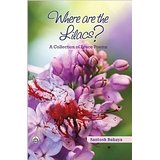
Where are the Lilacs? Santosh Bakaya


When one begins to read the first section of Santosh Bakaya’s poetic offering ‘Where are the Lilacs?’ one can be pardoned if one thinks that this is a litany of peace poems, poems that could have been showcased in the Romantic era of Wordsworth, Keats and Shelley. Nature is seen at her beautiful best, as she conspires to sing songs of peace in her myriad forms. The joy of the rain, “the delectable petrichor”, adds a new essence even as the moon hums a peace song. Various species of birds – sparrows, goldfinches, love birds, canaries and doves continue “their litany of freedom” as dolphins cavort with the mermaids. The poet calls the moon her friend, guide and philosopher as she “hugged the moonbeams as they beamed/in my tiny heart”. The chubby five-year old savours the thrill of a rain holiday even as a desolate farmer grieves at his savaged fields.
The Lidder is a motif that stirs dreams within the heart of the poet, as it tickles her feet. The motif meanders on to a young girl who gazes at the river’s immensity with her blue eyes. There is intense joy in this set of poems as playful verbs dance across the pages... sparrows hop, a young lad dances in the rain, laughing doves chortle, squirrels slither and “a girl in a boat/...catches the raindrops on her face/And laughs and laughs”.  The strains of peace sound in many of the poems, as even the trees sway and sing of peace.
However, there are moments when one is reminded of Tennyson’s “Nature, red in tooth and claw” when a happy child sleeps eternally after an explosion as “the lullaby freezes on petrified lips” or a vicious gale shatters the peace somewhere.
One of the most poignant poems sings of ‘The Petite Flautist’ “unleashing melodies of magic by his flute/In his dreary corner”.
In Part 11, the mood turns a trifle militant as young and old march on, “fleeing war and poverty” as “the bombers bombed/ And dreams were entombed”. Here, the references are connected to the real world, with references to little Aylan who drowned on the beach (“the child’s heart-rending screams”), the courage of Rosa Sparks (“a woman of spark”), a dirge to Gowhar who fell victim to a tear gas shell in Kashmir, and a paean to David Martello who soared his performance of Lennon’s ‘Imagine’ against the backdrop of the Paris violence.
Santosh Bakaya reveals a tender heart that weeps at a grave new world that is cacophonous, filled with resentment and riddled with corroded idealism. One discerns shades of Maya Angelou as she sings, “Let the bird in the cage serenade us with its notes of peace.” She goes on to beseech it to stay safe in its cage for “outside insane humanity is on the rampage”.
There are also cadences of Matthew Arnold’s “darkling plain” and Wordsworth’s “Bliss was it in the dawn to be alive”.  Each of these strengthens the robust ideas that tumble out of the sparkling mind of the poet, as she continues to plead for peace. “Why should our battle cry be Hate? /Let the songs of/Peace/Resound and echo in the valley and dale,” and “My pen grows wings and sails with the feathered friends/Trying to forget a world gone berserk by its violent trends.”
This volume, replete with poems so relevant to the world today, and always, ends on a note of hope.
“Let us be together, little dove
All that the world needs is you
And a handful of love.”


Wednesday, September 14, 2016

The Broken Home by Lopamudra Banerjee


THE BROKEN HOME
English Translation of 
Rabindranath Tagore's 
Nastanirh
by
LOPAMUDRA BANERJEE


Blurb

The Broken Home (Nastanirh), the novella, takes place in late 19th-century Bengal and explores the lives of the aristocratic Bengali gentry who were part of the Indian Renaissance. Within the peripheries of such a distinct, culturally liberal society, the world of Charulata, Bhupati and Amal unfolds. Charu, the dreamy, melancholic young woman dreams of an idyllic literary world where she and her brother-in-law Amal, a budding writer would remain two discreet, indispensable entities. However, Amal’s estrangement destroys her creative passions and creates an ocean of turmoil in her life that turns her marital world upside down. Her husband, Bhupati, despite his liberal ideas, is blind to her loneliness and dissatisfaction. It is only with the appearance of his cousin, Amal, in their lives, who incites passionate feelings in Charu, that Bhupati realizes what he has lost.

Nastanirh is the basis for the noted film, Charulata (1964), by Satyajit Ray. 


Grab your copy @


About the Author


Lopamudra Banerjee is a writer, poet and translator, currently based in Dallas, USA. She is the co-editor of ‘Defiant Dreams: Tales of Everyday Divas’, published by Readomania in collaboration with Incredible Women of India. Her unpublished memoir Thwarted Escape has been First Place Category Winner at the Journey Awards 2014 hosted by Chanticleer Reviews and Media LLC. She is also the Creative Editor of Incredible Women of India and a resident editor with Readomania.

Her poems, stories and essays have appeared at numerous literary journals and anthologies, both in India and the US.  She is a regular contributor for CafĂ© Dissensus, Different Truths, Readomania.com. She has received the Reuel International Award 2016 for translation also a Certificate of Merit as part of the Reuel International Award 2015 for Writing and Literature. 


You can stalk her @


   This Tour is Hosted by 


We Promote So That You Can Write 


Friday, September 9, 2016

A Symphony of Chance Encounters by Sayujya Sankar


How beautifully this young author has interwoven music with an interesting array of encounters that swell the soul as one reads about them! Sayujya Sankar has written a book that needs to be read, as much for its literary language and its choice poetry, as for the stories that leave an impact once the reading is done.
Whether it is ‘A Sane Insanity’ of a woman in turmoil , the saga of a childhood friendship that suddenly ends in tragedy in ‘A Carton Full of Love’, or the unlikely bond between an erudite college teacher and a construction worker who gives her a glimpse of his life, the words touch the heart. In the last mentioned, the words “Another half narrative” leave the reader with a sense of intense pathos at the end of “An Incomplete Building”.
In ‘Wisps of Grass’, a writer with a successful formula comes across a nonchalant young woman who dares to criticize his writing, and the reader is drawn into a relationship which turns gentler as it progresses. The intense loneliness that comes through in ‘Alone’ contrasts brilliantly with the joy that is experienced by two lovers in the symphony ‘Wonderful Tonight’, taken from the Eric Clapton song. “The caged bird in me opened its prison doors and flitted into the summer skies.”
What I cannot stop admiring is the beauty of the language that is so akin to poetry.   ‘Aarohi’ reveals a bewitching play of words revolving around two strangers, a dancer and an aspiring dancer, who hear a melody in their heads, which brings them together in a crescendo of music and rain. “In the picture in her mind, she raises her hands in a dramatic act – feeling an invisible coffin around her.” In ‘Perforated Perfumes’, reminiscent of Chitra Banerjee’s ‘Mistress of Spices’, one can almost smell the fragrances bottled up in coloured glass, for she, the shop, “contains all the secrets on the world.”
‘Of Dragon Fire and Cuckoo Song’ sings of Neha from Chennai and Thangjam from Manipur , bringing out “the differences between her dragon fire and the crackling of his kitchen flames”.
However, my favourite story of all (and it was one difficult choice!) remains ‘An Almost Rendezvous’, where, amidst cups of creamy hot chocolate in a cafe, a young college student finds inspiration from a woman writer through just a Neil Gaiman quote scribbled on a piece of paper left under a tray.
Every story is preceded by a poem that gives one a hint of what lies ahead.  Sayujya proves that she has music in her soul as she turns strangers into friends and more, through musical notes. This book is certainly going to make her many friends and admirers.
“The words merge.
The thoughts flow to engulf each other.
And now, we hear
A symphony

Of chance encounters.”

A Symphony of Chance Encounters by Sayujya Sankar


How beautifully this young author has interwoven music with an interesting array of encounters that swell the soul as one reads about them! Sayujya Sankar has written a book that needs to be read, as much for its literary language and its choice poetry, as for the stories that leave an impact once the reading is done.
Whether it is ‘A Sane Insanity’ of a woman in turmoil , the saga of a childhood friendship that suddenly ends in tragedy in ‘A Carton Full of Love’, or the unlikely bond between an erudite college teacher and a construction worker who gives her a glimpse of his life, the words touch the heart. In the last mentioned, the words “Another half narrative” leave the reader with a sense of intense pathos at the end of “An Incomplete Building”.
In ‘Wisps of Grass’, a writer with a successful formula comes across a nonchalant young woman who dares to criticize his writing, and the reader is drawn into a relationship which turns gentler as it progresses. The intense loneliness that comes through in ‘Alone’ contrasts brilliantly with the joy that is experienced by two lovers in the symphony ‘Wonderful Tonight’, taken from the Eric Clapton song. “The caged bird in me opened its prison doors and flitted into the summer skies.”
What I cannot stop admiring is the beauty of the language that is so akin to poetry.   ‘Aarohi’ reveals a bewitching play of words revolving around two strangers, a dancer and an aspiring dancer, who hear a melody in their heads, which brings them together in a crescendo of music and rain. “In the picture in her mind, she raises her hands in a dramatic act – feeling an invisible coffin around her.” In ‘Perforated Perfumes’, reminiscent of Chitra Banerjee’s ‘Mistress of Spices’, one can almost smell the fragrances bottled up in coloured glass, for she, the shop, “contains all the secrets on the world.”
‘Of Dragon Fire and Cuckoo Song’ sings of Neha from Chennai and Thangjam from Manipur , bringing out “the differences between her dragon fire and the crackling of his kitchen flames”.
However, my favourite story of all (and it was one difficult choice!) remains ‘An Almost Rendezvous’, where, amidst cups of creamy hot chocolate in a cafe, a young college student finds inspiration from a woman writer through just a Neil Gaiman quote scribbled on a piece of paper and left under a tray.
Every story is preceded by a poem that gives one a hint of what lies ahead.  Sayujya proves that she has music in her soul as she turns strangers into friends and more, through musical notes. This book is certainly going to make her many friends and admirers.
“The words merge.
The thoughts flow to engulf each other.
And now, we hear
A symphony

Of chance encounters.”

Wednesday, September 7, 2016

The Prince's Special Bride by Devika Fernando


Devika Fernando could not have chosen more beautiful locales for her latest romance – ‘The Prince’s Special Bride’ (Royal Romance Book 1); Maldives with the most beautiful sunsets in the world, and Taragonia, “the gem with sparkly colours and shiny royals.”
Marie Kemei, the Night Manager at Kuramathi Island in the Maldives, has the perfect job. She is intrigued by the enigmatic Liv, a strikingly beautiful, mysterious guest who hides behind a hoodie and dark glasses. They strike up a friendship, as the stranger confides that she needs a short breather to rid herself temporarily of the sword hanging over her head.
Marie is intrigued but does not want to probe. Her advice to Liv is to forget who she is and make the most of the holiday, and in the process, make enough memories to last a lifetime. Marie has had her share of tragedy in life and she knows what it is to help someone live a little. A makeover and a change of wardrobe turn Liv into a younger and sexier woman with fighting spirit and daring.
The introduction of Christian, Liv’s brother, is equally intriguing for Marie, as she looks on at the siblings with “enthralling green eyes and strange inherent grace.” Christian has come to take back his sister, Olivia, the Crown Princess of Taragonia, who is to be married to the Crown Prince of Visteria. It is only just before they leave that Marie realizes that she has been hobnobbing with royalty.
Christian is almost Darcy-like in his persona, as “he stood like a silent sentinel, untouched by the laughter, glass-clinking, singing and dancing around him.” However, he and Marie develop a strange attraction, even though he disapproves of the manner in which she has helped his sister transform from “a rare moth of royal grandeur to a vivacious butterfly of startling appeal.”
The tempo of the book suddenly changes as Marie finds herself invited by Olivia to Taragonia for the royal wedding. She finds herself an outsider, in this “intimidating yet fascinating place”, as she tries to find her bearings. She breaks many rules of correct behaviour, as she tries to adhere to the formality of the royal family. Christian does not make it any easier for her with his stiff–necked pride and traditional outlook.
Marie never really does settle down in the gilded cage, but Devika Fernando adroitly showcases the changes in her feisty heroine’s perceptions, as she realizes that “royalty wasn’t only about riches and outdated customs, rigid rules and unfair advantages.” The royals have their moments of being human and charitable as well.
Beautiful descriptions make the reader see the places through the author’s eyes, even as Marie observes that life in Taragonia is like being “in a fairy tale, but much realer in its gilded-cage impression.” While Christian is singularly focused on what is best for his kingdom, his mother, the Queen, reigns supreme, forbidding and autocratic, “her piercing blue eyes, which swept over everyone and everything in a heartbeat, seeing all, judging all, never letting themselves be touched by anything.”
What are the circumstances that turn an unwilling Marie into the Prince’s special bride? Is she able to stand up to the challenges before her? Who is the one person who stands in between her and happiness? Devika Fernando proves once again that romance is her metier in the midst of all the intrigue in the royal court.
Maybe that is why there are lines of sheer poetry in the book, when Marie is described. “Everything she did was like music, a startlingly charming tune that took a classic and reinterpreted it – neither too different nor a mere imitation.”
Another line that remains with the reader even after the book has been read is uttered by Christian to Marie. “You are the one who can make it a fairytale or choose to let others write and ruin your story.” Isn’t that a universal truth, after all?


The Broken Home by Lopamudra Banerjee


There are many, many people who would love to read Guruji Rabindranath Tagore's memorable works, and Lopamudra Banerjee has striven to translate his 'Nastanirh' into English in the form of 'The Broken Home'. This is no easy task, but Lopa has shouldered it with ease, and given the readers a true feel of the original through her understanding of the classic and her eloquent style.


THE BROKEN HOME
English Translation of 
Rabindranath Tagore's 
Nastanirh
by
LOPAMUDRA BANERJEE


Blurb

The Broken Home (Nastanirh), the novella, takes place in late 19th-century Bengal and explores the lives of the aristocratic Bengali gentry who were part of the Indian Renaissance. Within the peripheries of such a distinct, culturally liberal society, the world of Charulata, Bhupati and Amal unfolds. Charu, the dreamy, melancholic young woman dreams of an idyllic literary world where she and her brother-in-law Amal, a budding writer would remain two discreet, indispensable entities. However, Amal’s estrangement destroys her creative passions and creates an ocean of turmoil in her life that turns her marital world upside down. Her husband, Bhupati, despite his liberal ideas, is blind to her loneliness and dissatisfaction. It is only with the appearance of his cousin, Amal, in their lives, who incites passionate feelings in Charu, that Bhupati realizes what he has lost.

Nastanirh is the basis for the noted film, Charulata (1964), by Satyajit Ray. 


Grab your copy @


About the Author


Lopamudra Banerjee is a writer, poet and translator, currently based in Dallas, USA. She is the co-editor of ‘Defiant Dreams: Tales of Everyday Divas’, published by Readomania in collaboration with Incredible Women of India. Her unpublished memoir Thwarted Escape has been First Place Category Winner at the Journey Awards 2014 hosted by Chanticleer Reviews and Media LLC. She is also the Creative Editor of Incredible Women of India and a resident editor with Readomania.

Her poems, stories and essays have appeared at numerous literary journals and anthologies, both in India and the US.  She is a regular contributor for CafĂ© Dissensus, Different Truths, Readomania.com. She has received the Reuel International Award 2016 for translation also a Certificate of Merit as part of the Reuel International Award 2015 for Writing and Literature. 


You can stalk her @


   This Tour is Hosted by 


We Promote So That You Can Write 


Monday, September 5, 2016

The He'art' of Teaching


“No, I’ll never teach; it’s not in my blood!” I completed college on that dramatic note. And at that time I fully believed in what I said. I got married to an Army officer, and after six years, I decided to take a plunge into the profession I had professed to dislike.
Little Flower Convent, Gurdaspur, opened its portals to me. I strode into class confidently with the children looking on with undisguised interest. I was wearing a sari to make myself taller and fatter.
I walked into the eighth standard and tried my eloquence on them. Fifty minutes, a dry throat and a dozen wisecracks later, I had convinced them that English is, indeed, a beautiful language (which I firmly believe from the bottom of my heart). I assured them, then and there, that they would not be subjected to that commonest of classroom maladies – boredom, for there would ne’er be a dull moment.
And so it proved! I summoned all my powers of narration, ticked my sense of humour, illustrated my lessons with sketches on the board (the more ludicrous the better!) and visual aids that no B.Ed Degree could have foreseen. And my children responded! They picked up the parts of speech (which already they had delayed enough) and learnt that grammar is spelt with an ‘a’ and not with an ‘e’. They tried reading with the correct pauses, and paused when really in doubt. Every time I could add some relevant piece of information to the patchwork of language forming in their minds, I did so. Their essays left the commonplace and widened out into realms of originality. Their letters sparkled with a few gems picked out of their own minds. They spoke, at first bashfully, and then with greater confidence. Finally I even had to stem the tide at times. But it was worth the effort.
I remember one particular boy who used to slouch onto his bag that was always on his desk. One day he was sitting at the back of his class, as busy as the proverbial bee. I stopped the lesson and watched with interest as he continued, engrossed in his task. The others caught on. “Ma’am, he has stuck a tail on the boy next to him.” I summoned him to the front and admired the tail. He had to stand with his ‘tail’ tucked in and explain the relationship between man and the ape. Not surprisingly, he was made the butt of many a ‘tale’ around school for many days. And in the process, I had added a fan to my circle.
Before long I had to quit Gurdaspur because my husband was posted out. The second terminals had just got over and my successor would take over any day. I was overwhelmed by the reactions of my children. I had been around only for two terms and they had found their way into my heart. My house was just round the corner and every day, I found hordes of students coming over to talk to me because they missed me in school. My fingers ached with the number of autograph books I wrote on. My heart swelled at the beautiful cards I received, cards I would cherish all my life. One of them read – “What do you have in common with the Mona Lisa, the Hope Diamond, the Sistine Chapel, the Parthenon and Shakespeare’s plays?” The answer – “You’re all priceless,” tugged at my heartstrings, as did the love that was so palpable and the warmth that made even the cold winter days bearable.
The day before I left school, one of my classes called me to say “Goodbye”. They gave me a farewell gift from the class. More beautiful than the gift were the sentiments they expressed. The monitor cleared her throat. “Ma’am, we enjoyed your classes even more than you enjoyed teaching us, and we will never forget you.” I forgot all that I wanted to say and could only blurt out, “Children, I love you!”
Maybe I will never get those days back again. Life does have a flair for shortening sweet moments, but let it suffice to say that though my students claimed that they were the ones who benefitted by my teaching them, I can only reiterate that, had it been in my power to stop and turn the clock back, I would have, for I learnt from these little children the art of appreciation, the art of love and, above all, the ‘he’art’ of teaching.


#READTHENEW – #BLOGCHATTERA2Z CHALLENGE

  Pinterest Participating in the #BlogchatterA2Z Challenge this year was as exciting as it has been over the past few years. This year, howe...