Sunday, September 22, 2013

Watch Out for the Weirdos!


Dante’s Inferno could not be more chaotic, I muse! Our car crawls along on a surface, choc-o-bloc with vehicles, bumper to bumper in four wavy lanes, originally meant to house two orderly lines, ‘orderly’ being a misnomer, of course! The signal glints red, and before it turns ochre, buses start blowing their horns frantically, noisily revving their engines. The car ahead moves forward tentatively, not wanting to ram into a scooter that is a miracle in itself, with five people clinging on to one another - a father, a mother and three children of varying sizes, all pasted together like a club sandwich! The bus behind complains incessantly, ignoring dirty looks, as the signal turns green with reluctance, and a cacophony of horns break out, as at the start of an ancient battle.
As the vehicles begin to move, two jay walkers dart across the road, holding up their hands in supplication, causing curses to add to the confusion. An auto rickshaw driver, hardly the most polite homo sapien alive, sticks his head out, hawks loudly and lets out a stream of red spittle, narrowly missing our windscreen. Our driver screams at him, and the aforesaid homo sapien decides to sidle out, finger his collar and stick his head through our window to scream back. By now one can sense tempers around us getting frayed.
Four lanes of vehicles lurch forward, brakes squeal and heads hit windscreens, smoke and pollution redden eyes, and the stench of petrol [for those who hate the smell!] fills the interior, making me gag! On one occasion, we were stuck at a signal, and my daughter, who gets car sick at the sight of a car, felt faint. On the other side, my mother lolled against her window, trying not to breathe in the fumes. I was caught between them, wondering whom to attend to first. When the car moved, both recovered, but not before they had scared the daylights out of me!
One television advertisement always evokes a smile, the one that says, “Watch out – there are idiots on the road!” So true, especially when you are cruising along happily and suddenly an energetic driver cuts from your left, and zooms across to take a cheeky right, millimetres in front of you! And to add insult to injury, he has the gall to flip the finger at you as well! Or the woman who puts one tentative foot out to cross the road just as the traffic gets going, causing folks to swerve violently. No wonder my aunt says all her prayers in the car!
Most rule breakers are educated, canny, and oh-so-well behaved when they drive anywhere abroad. They stick to their lanes, avoid honking and wait for pedestrians to cross the road patiently. However, the moment they drive in India, a little imp forces them to run berserk, skittering around like cats on a hot tin roof.
Maybe the only time drivers do slow down is when they are forced to do so! Like when a VIP makes an appearance, causing a galaxy of cops to stand around, mobiles in hand, waiting for a sighting in the horizon which causes them to stand to attention, while a mighty traffic jam forms around, growing larger every restive minute.
And to end, a grandfather would take his young granddaughter driving every Sunday in order to bond with her. Once he fell ill, and his wife opted to take the little girl out. When they got back, the grandfather asked the little one how she had enjoyed her drive. Prompt came the reply, “It was fun, and guess what! We didn’t see a single ‘Idiot’, ‘Moron’ or ‘Blind Fool’ on the way today!”

Deepti Menon


Wednesday, August 14, 2013

"As Beautiful as Your Work!" Contest


Beauty, it is said, lies in the eyes of the beholder! As I behold my mother, Nalini Chandran, the beauty of the universe comes together, even as she lives life, queen-size, even at the age of 76. Do I feel this way because I fell in love with her, the day I opened my eyes for the first time, only to see her smiling down at me in wonder? Life was more vibrant when she was around, getting me ready for school, taking a history lesson where I was part of a rapt class, or moulding my nature to mirror hers as she made friends, with the ease of a butterfly drawing out honey from a willing flower!
She never preached, just led by example. Her home was always filled with friends who drew inspiration from her joie-de-vivre. A teacher all her life, she honed her skills, only to create a wonderful school, which started with six students and went on to take her home town by storm, as it took on her wonderful personality and made it its own. She loved being with children, as she turned into a child, gamboling with them like a frisky lamb. Yet she could be a lioness in her den with errant students or cursory teachers.
History and Literature were subjects which she adored! She took pains to make them come alive, as her silver tongue combined facts with trivia, and transported her students into a world of knowledge and pure fun. Whether it was the three witches in Macbeth or the advent of Mohenjo Daro, Nalini Miss, as she was universally called, would make it fun! No wonder, her students remembered her classes with fondness, years after they left school!
But that was not her only passion! “My students have to be citizens of the world!” she often declared. She made it her mission to instill ideas of etiquette and behaviour, soft skills as they are called today.  Respect to elders and honesty to the core were also part of her educational programme.  Her amazing sense of humour  and her outspokenness were also traits she shared with people, traits she loved to see in people around her.
The true beauty that we have seen in her, over the decades, is her zest for life that keeps her going. She can drop everything and decide to traipse around the country, with a crazy British friend, also a grandmother, and end up having adventures with gusto! Her heart is so large that she can be taken in by sob stories, and she loosens her purse strings with ease. Whatever the case, life can never be dull when she is around, and maybe that is exactly why her repertoire overflows with life experiences that could fill reams of paper! And maybe why  she shines on like a jewel,  even though she is unaware of her own lustre, a fact that endears her to many! May her tribe increase!

By Deepti Menon 


Mia, in the TV ad, embodies the true woman of substance. She is vibrant, confident and very much a woman of the world. Her Tanishq earrings go perfectly with her personality as they are fun, beautiful and eye catching, just as she herself is! 

 http://mia.tanishq.co.in/

Real men trump celluloid heroes

Gone are the days when heroes in Hindi films ran after buxom heroines with coquettish pouts, dragging them down forcibly, and wooing them with typical caveman techniques, singing songs to kindle sparks in their fluttering hearts. Today’s macho man prefers to show off his six packs, and handle wicked villains with one flick of his arm, along with dialogues on orifices in the body. These men are unreal heroes, meant only for celluloid. Who is a real man in today’s world?
So much depends on upbringing. A man who abuses his wife, strikes and enslaves her will have sons made from the same mould. On the other hand, a man who adores his wife and does little things to keep her happy, and treats her with respect and love will father sons who grow up with the same values. The child is the father of the man, after all!
Real men do not think they are God’s gift to women. They appreciate their womenfolk, treat the elderly with reverence and love their fellow human beings, which brings to mind the wondrous poem Abou Ben Adhem.
Real men play sports and learn to win with honour and lose with grace. They work in tandem with others, without giving in to ugly rage which makes them lose their heads and resort to violence. Real men are never bullies, who start ugly fights with those weaker than themselves, and yet, turn into blubbering jelly when accosted by someone stronger. Real men can not only defend themselves, but those along with them, and always stand up for the truth.
Education and knowledge play a vital role in defining what one is, apart from one’s basic nature. These, along with generous doses of advice and grandma’s tales, go a long way in moulding the character of the young child. A boy who has a good moral grounding and a loving family will rarely go wrong in life.
The grown man is strong and tender at different times. He ensures that the women in his life realise their potential, and do well in whatever they want to do. His is the sturdy shoulder they lean on, but it is not unmanly to give in to grief and use their shoulders, in times of need.
Real men do not mind admitting that they enjoy churning out delicious dishes or buying groceries for home. They are ready to change diapers of babies at midnight or keep a hot water bag for their spouses who return home after a stressful day. A sense of humour can be a great ice-breaker. Little spats add to love, as long as they are not carried on till they turn serious. When things go awry, a really bad joke or a silly pun can bring back equanimity. A family that laughs together stays together. And a family that stays together will have men who care.
The key word in a great relationship has always been “respect” — towards every person who comes one’s way, chivalry towards women of all ages, and the realisation that every creature on earth has the right to live freely.


22nd July 2013 07:24 AM 
The New Indian Express

Master who Learnt from beggar, baul


28th July 2013 12:00 AM
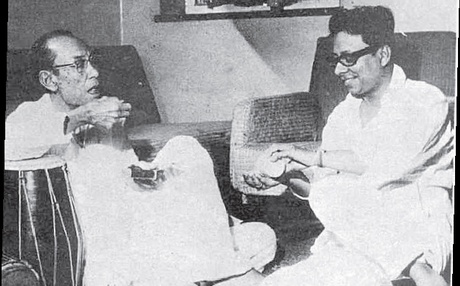
Before becoming a household name, Sachin Dev Burman had become synonymous at the start of his journey with the Tippera flute, Tripura’s own instrument. So much so that for those who knew him “the haunting tunes of the flute in the dead of the night would convey the message far and wide: Sachin-karta was in town”!
Khagesh Dev Burman’s biography, translated from the Bengali version by the author and S K Chaudhuri, is filled with such delightful anecdotes and rich details of the legendary composer. It begins with a twist of circumstances, establishing S D Burman’s royal antecedents, and of how in the succession struggle that ensued, his father, Nabadwip Chandra, was deprived of his rightful due, the kingship of Tripura. As a result, he moved to his palatial home in Chartha, Comilla, where Sachin was born on October 1, 1906, the youngest of nine siblings. From the start he was surrounded by music. His father was a painter, sculptor and sitar player with an outstanding voice. His mother, Nirupama Devi, was from the royal family of Tripura and loved music and dance.
Sachin was deeply influenced by the two cultural streams of his lineage and the mysticism of folk music pervading Tripura. He once spoke of everyone in the Tripura palace singing – the king, the queen, the maids, the servants even. “Perhaps that is why I spent my entire life on songs and songs alone — music is my first love.” He imbibed the musical spirit of the common folk, breaking free of the palace culture to create a new tradition that would, one day, be revered. He started losing interest in studies, and was sent to Kumar Boarding at Agartala, and later Yusuf School back in Comilla, relieved that he could resume music lessons from his father, as well as roam around in rural Bengal, and “like a honeybee collecting and storing honey, build his collection of tunes and music”.
Sachin continued his quest for musical jewels, with no qualms about lessons from “the farmer and the boatman, the beggar and the baul, the fakir and the servant”, striding into film music to be one of the greatest.

Saturday, May 18, 2013

Equality fight in an unequal world #Feminisn #bookreview #SundayReading

Feminism is not being part of an organisation; rather it takes inspiration from past heroines, aiding women to feel a continued responsibility, explains Nivedita Menon’s Seeing Like a Feminist. The title is inspired by James Scott’s Seeing Like a State, where the state “seeing” is all powerful, compared to the marginal position of the feminist.
This is a book about women and patriarchy, and about how the feminist views the operation of gendered modes of power. It is divided into six chapters, which deal with vital, interrelated themes.
Efforts have always been made to shield the institution of the patriarchal heterosexual family. Couples who choose inappropriate marriage partners come under the scanner. Women have been relegated to domestic work, which is less valued and unpaid, despite the Equal Remuneration Act of 1976. Domestic work is more demeaning and exhausting than that of a sex worker, probably why 71% of ‘servants’ have moved voluntarily to sex work.
In North India, a woman has no rights in her natal home after she moves to her husband’s home. In Kerala, only vestiges of the matrilineal system are seen. The Hindu Code Bills empowered Hindu women to choose their partners, and marry outside their caste. The Hindu Women’s Right to Property gave widows rights to their husband’s property, but the Hindu Succession Act nullified the position of daughters under matrilineal laws, by granting equal inheritance rights to sons. The three interlinked features of the Indian family are patriarchy, patriliny and vivilocality.
Dowry has spread its tentacles almost everywhere, as women go to their husband’s homes to survive with limited rights, despite the Dowry Prohibition Act which deems both giver and taker guilty. Women, right from childhood, prepare for marriage, which sometimes leads to the ‘implosion of marriage’, when young girls refuse to conform to docile roles of wife and daughter-in-law. The author avers that feminists need to build up the strength to live in ways in which marriage is voluntary, and create alternate non-marriage communities.
In ancient times, the universality of gender as a social category was challenged in African and the North American countries, and even in the lives of the Bhakti saints. But the creation of a distinction between sex and gender is intrinsic to feminism, as from childhood onwards, girls and boys pick up gender-specific forms of behaviour, training to conform to set roles.
In the 1990s, the media began airing sexually explicit images, through cable and television channels. Questions on homosexuality and issues revolving around the civil liberties of eunuchs, bisexual and transgendered people have all been viewed through the lens of the feminist here.
Patriarchal forces call rape a blot against family honour, while feminists denounce it as a crime against a woman’s bodily integrity. The Pink Chaddi protest was a non-violent gesture of ridicule against intolerance. The modern slut walks are the latest chapter in a long, powerful history of inspirational feminist struggle.
Caste politics and patriarchy have stalled the passing of the Women’s Reservation Bill to reserve 33% of seats in Parliament for women.
There is mention of the commoditisation of the female body, through advertisements showing scantily clad bodies and pornography. Feminists expose how this outlook can be transformed by thinking of women as consumers instead of victims.
Pregnancy and child bearing are the sole responsibility of the woman. The ideal feminist world is one in which women can control when and under what circumstances they deliver their children. Sexual harassment charges against celebrities, the ban of the veil in France, forcing women badminton players to wear skirts and queer politics have all been touched upon in this revealing book.
Thus, for Nivedita Menon, feminism is not about one triumphant moment against patriarchy, but about the ongoing shift that enables young women to say, “I believe in equal rights for women, but I’m not a feminist.” Many new positions, energies and challenges have transformed the feminist field over the years, and this book takes a bold look at these.
“It comes slowly, slowly, feminism does. But it just keeps on coming!”
 

Saturday, February 9, 2013

Made in heaven but born in war

The love story of Lt General Prem Bhagat and his wife Mohini has now been preserved for posterity by their adoring daughter, Ashali Varma, whose life was transformed by the people who worshipped her charismatic parents. The much-admired Mohini from cosmopolitan Poona, was “mesmerised by... the kindliest and most compelling eyes she had ever seen.” Commissioned in 1939, Prem joined the Bombay Sappers and was assigned to 21 Field Company—an event that would catapult him to fame as an expert in explosives and building bridges and roads. From North Africa in 1940, Prem wrote long and chatty letters to Mohini, peppered with humour. When he witnessed the horrors of war, with lives snuffed out in seconds, he felt guilt and sorrow, emotions that he hid from her. On January 31, 1941, the retreating Italians booby-trapped the roads with mines. Prem, leading from the front, had two close shaves with death. He ran into an ambush. The powerful blast shattered his eardrum. Yet he continued what his Commanding Officer termed “the longest continued feat I have ever seen of sheer cold courage”. The feat won him the Victoria Cross, the highest British award for gallantry! The book has anecdotes and memorable photographs. While having dinner at the Taj Hotel, Mumbai, to his embarrassment and her glee, the menu had a picture of him saluting, the Victoria Cross pinned on. He proposed to her over candlelight, and they got married on February 24, 1942. Marriage was a close, loving partnership. When Mohini was expecting her first child, Prem was worried about the pain she would undergo, as also about the new interest in her life. When their son, Dubby was born, he fell in love all over again. Nine years later, Ashali, completed their family. In 1949, as Commandant of the Bombay Sappers, he turned the outfit into a model training centre, taking bold steps to unite his men by introducing common dining, clubs and sports facilities. Later, as Commandant of the Indian Military Academy, he would invite cadets for delicious home-cooked meals. The parents of the cadets, often from rural areas, were invited to pip their wards. Stress on values like loyalty and integrity was paramount. Towards the end of an illustrious career, Prem was cheated of the post of the Army Chief because he was outspoken and popular. Manekshaw, who considered him his natural successor, said, “The Army missed a first rate chief.” Mohini stood by his side. From Jammu to Calcutta, tearful jawans, officers and their wives mobbed them at every station. Post-retirement, Prem was made Chairman of the Damodar Valley Corporation. Once again, he left the stamp of his leadership with his concern for subordinates. The idyllic love story ended when Prem succumbed to a massive allergic drug reaction. Mohini asked for a ceremonial military funeral. As the nation wept at the passing of a war hero, Mohini stood dry-eyed, aware she had a lifetime ahead to mourn him. For 30 years, she kept his memory alive, having presented his Victoria Cross to the Bombay Sappers. Her end came after a painful struggle with cancer. 13th January, 2013 New Indian Express

Tuesday, February 5, 2013

Words of wisdom in Shakespearean style

A new son has just risen, one who earlier refused to be coerced into taking up a position of power, preferring to start as a mere worker. He made sure that he was visible, as he went around the villages, and sat down with the aam aadmi, having meals with them and making himself quite at home. However, D day is here! The young man has been taken into the bosom of his party, and is all set to take up the reins. As expected, the party members are thrilled, and have already begun suggesting that he is meant for higher, much higher things. Whoever said a rose by any other name would smell as sweet, was obviously not talking about our political scenario. A canny old man named Polonius in Shakespeare’s Hamlet is best known for having given some shrewd and practical advice to his son Laertes. Surprisingly, if one shaves the Bard’s language of its extra fittings and trims off the lard, the advice would be just perfect for the heir apparent, advice which his mother could offer to him, in the manner below: Do not speak all that you think, ‘give thy thoughts no tongue’, or act on rash desires, that are out of harmony with the occasion. Words calculated to make one look before one leaps, so as to say! Or again, in Shakespearean words, ‘discretion before valour’. ‘Be thou familiar, but by no means vulgar’. Be friendly, but remember that familiarity breeds contempt, and often, nepotism, as well. Be friends with a few, and keep them close to your soul ‘with hoops of steel’, but do not soil your palm by being over-effusive with every chance newcomer. Be respectful, but maintain your distance from sycophants and hangers-on who want to perch on your shoulder, and train their guns from there. Do not get provoked into fights, but if they are forced upon you, stand tall and give a goodly account of yourself — a principle that sits well in politics, where sitting on the fence is a well-known quality. Lend your ear to every man’s censure or opinion, but ‘reserve your judgment’. Too many gaffes by leaders and politicians have turned them into a laughing stock in today’s scenario. Cut your coat according to your purse, and dress elegantly, not ostentatiously, ‘for the apparel oft proclaims the man’. Cut down on affectation, so that others may not wonder just what you have been up to, to have obtained such wealth. ‘Neither a borrower or a lender be’, for you might end up losing the loan and the friend you held a hand out to. Think of all the diatribes and the poisonous words being used by allies who are dissatisfied with what they have been given, all regular Oliver Twists! The most vital piece of advice of all ... ‘to thine ownself be true!’ Set high moral standards for yourself and for those around you, stick to your principles, and remain above reproach, like Caesar’s wife. Behave responsibly and practically, make integrity your watchword! Isn’t it strange how a master wordsmith from the Elizabethan era could make such perfect sense even today? By Deepti Menon 26th January 2013 07:36 AM

THE SIMPLEST GUIDE TO RELIGION – UNDERSTANDING HUMANITY’S SEARCH FOR THE SACRED BY TOMICHAN MATHEIKAL - BOOK REVIEW

  Amazon.in “There is something eternal in religion.” Emile Durkheim Author Tomichan Matheikal’s book titled ‘The Simplest Guide to Religion...